
Railways in
Colombia
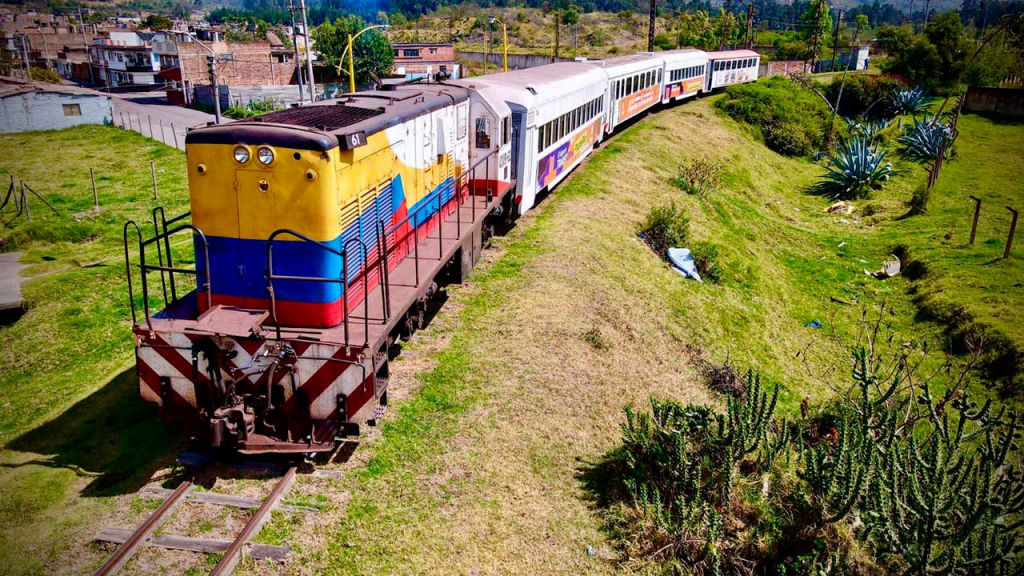
El Tren de la Vida y la Esperanza between Paipa and Sogamoso
Locomotive U10B-61 is a 900hp Bo-Bo of General Electric design built under license in Spain
The first railway in Colombia was in fact the Panama Railroad which crossed the isthmus of Panama in 1855. However, in 1903, Panama became a country in ins own right; as a result, the first railway in present day Colombia was the line opened in 1871 between Barranquilla and Sabanilla (present day Puerto Salgar), a distance of about 22km. The gauge is variously reported as 1080mm or 1067mm; however, subsequent railway development in the country was mainly to a gauge of 3ft (914mm).
The much run down and near bankrupt national railway system all but closed down in the late 20th century. Passenger services ceased and an international link with Venezuela was severed. Freight services were franchised to two companies, operating separate groups of lines on the Atlantic and Pacific sides of the country.
The Pacific group as concessed was a 500km line from the port of Buenaventura via Cali to Zaragoza, with a branch from Zarzal to La Tebaida. The line was allowed to fall into a bad state of disrepair and latterly only the 196km section from Buenaventura to Palmira, just north of Cali, was reported as operating. Trains ceased running completely in 2017. In the absence of any progress in restoring services, the concession was withdrawn in 2020 and is to be retendered.
The Atlantic group was a single route, about 250km from the port of Santa Marta to Chiriguaná. A 522km abandoned section of line continuing from Chiriguaná to La Dorada was restored to traffic in 2016. A separate section of the same abandoned line, 318km from Facatativá via Bogotá to Belencito with a branch from La Caro to Zipaquirá, was reopened to freight traffic in 2018. Part of this line had previously been used to carry a tourist train service from Bogotá to Zipaquira, and continues to serve that purpose.
Apart from the main lines, there is an independent (1435mm standard gauge) mineral railway opened in the 1980s, and the Medellin Metro opened in 1995.
In 2025, a tourist service was introduced between Paipa and Sogamosa on the Bogotá to Belencito main line.
Also in 2025, it was announced that funding was available to progress the Tren del Río, a dormant project for a 30km freight and commuter rail link from Bello (where there would be interchange with the Medellin metro) to Barbosa, on or near the route of the former Antiquoia Railway, which had been closed in the 1960s.
© 2006-2025 Glyn Williams
Photo image: Colombia Ministry of Transport