
Railways in
Nepal
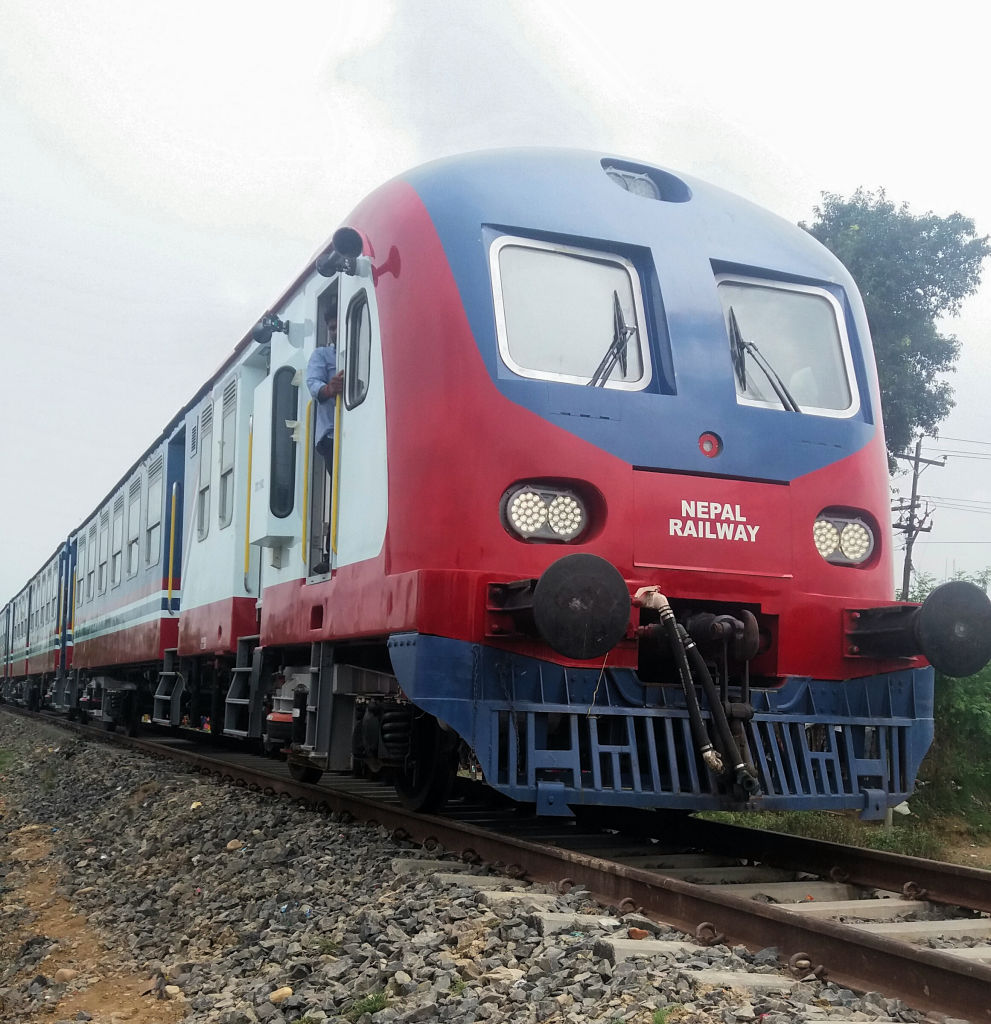
A Nepal Railway passenger train at Janakpur, one of two multiple units supplied by Konkan Railway of India.
The first railway in Nepal opened in 1927 from Raxaul (India) to Amlekhganj, a distance of about 48km (46km in Nepal). It was built to 2ft 6in (762 mm) gauge. The line closed in 1960. Part of the route was subsequently used for a 6km broad gauge (5ft 6in, 1675 mm) branch line from Raxaul to the Inland Container Depot at Sirsiya, near Birgunj. The new line opened in 2005 and is used exclusively by freight trains operated by Indian Railways.
The original line was joined in 1937 by a separate 2ft 6in (762 mm) gauge line, running for about 53km (50km in Nepal) from Bijalpura via Janakpur to Jaynagar (India), where there was interchange with a line of the Indian Railways network. The section from Bijalpura to Janakpur closed in 2001 following a bridge collapse. The remaining 29km of the line from Janakpur to Jaynagar continued in operation, albeit rather erratically, for local passenger traffic with some freight until 2014, when it was closed for conversion to broad gauge. It reopened in 2018. A 17km extension to the original terminus of Bijalpura opened in 2023. Passenger services are operated by Nepal Railway. A further 17km extension to Bardibas, not part of the original route, is proposed.
Around 2010, proposals emerged for several major new railways. A 945km electrified line is planned to run the length of the country from Kakarvhitta in the east to Bhim Datta in the west, continuing to the Indian border at Gaddachowki. Construction of the first 108km section from Bardibas to Simara commenced in 2014, and is ongoing. A number of smaller projects totalling some 180km are proposed, mainly concerning cross-border connections with India.
In 2024, a Chinese pre-feasibility study was completed for a new 628km standard (1435mm) gauge railway which would link Kathmandu and Xigazê, Tibet, via a border crossing near Rasuwagadhi. About 72km of the line would be in Nepal. Extensions from Kathmandu to Pokhara and Lumbini are envisaged.
In 2026, expressions of interest were invited to conduct a project report for a transit system in the capital, Kathmandu. A 27.5km loop is envisaged, which may be heavy rail, light rail, or monorail.
© 2005-2026 Glyn Williams
Photo image by Tulsi Bhagat from Wikimedia Commons