
Railways in
Yemen
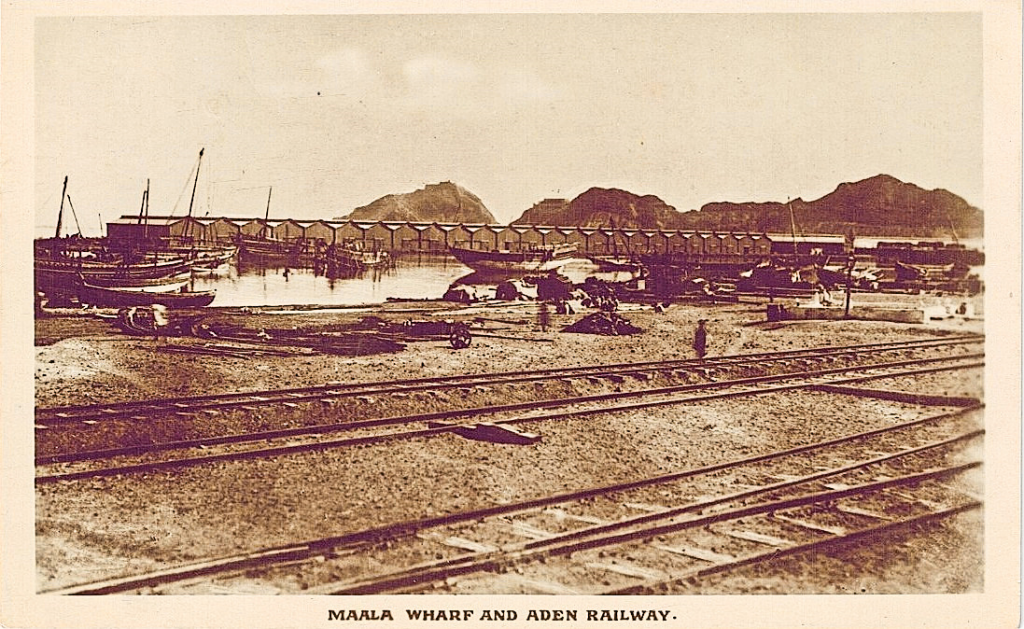
Mualla Wharf in the port of Aden, from a postcard published in the 1920s.
The lines in the foreground are those of the Aden State Railway;
just beyond are those of the Aden Port Trust Tramway.
In 1868, some railway equipment was imported to the British controlled port of Aden, with the intention of building a short railway to facilitate military operations within the port territory. It is believed to have been metre gauge equipment recovered from Abyssinia. No railway was constructed at that time, though it is not known whether some of the material may have been used for the later Aden State Railway.
Around 1897, the Aden Port Trust constructed a 2ft (610 mm) gauge tramway to service the port. It was reported still in operation in 1937; it is not clear when it closed.
In the early 1900s, there were several proposals for railways in Aden, but none came to fruition.
In 1911, the Ottoman Empire started work on a railway connecting the port of Al Hudayah with the major city of Sanaa, partly in response to the growth of anti-imperial influences in the area; it was never completed.
In 1916, British military forces constructed a railway in Aden to support operations against Ottoman forces. The line was metre gauge, and ran for 7 miles (11 km) from Mualla in the port area of Aden to Sheikh Othman on the border of the British controlled territory. Following a successful repulse of the Ottomans, the line was extended into the Aden Protectorate, a loose federation of sultanates allied with the British. The railway reached Lahej in 1919, and Al Khudad the following year, giving a total length of line of 29 miles (46 km). Shortly after its completion, the line was transferred to civilian control as the Aden State Railway. It was never a great success, and closed to traffic in 1929.
© 2004-2026 Glyn Williams
Photo image believed public domain